What is AI ERP?
AI ERP is an ERP system where the AI does the operational work itself. It reads customer enquiries, matches products and SKUs, drafts quotations and invoices, and flags exceptions. Your team reviews and approves. Traditional ERP stores your data while humans do the work. AI ERP does the work while humans supervise.
Your ERP is a filing cabinet
Most Singapore SMEs run their operations on systems that are excellent at one thing: storage. Orders, invoices, stock levels, customer records, all neatly filed. The software remembers everything and does nothing.
Which is why the typical distributor's office looks the same as it did fifteen years ago. A row of staff reading emails, retyping them into the system, searching for product codes one at a time, copying prices from an Excel sheet, building quotations line by line. The company bought software to reduce manual work and ended up creating a new manual job: feeding the software.
The vendors call the fix “customization” and quote six months and five figures for a single workflow. So nothing changes, and the headcount grows with the order volume.
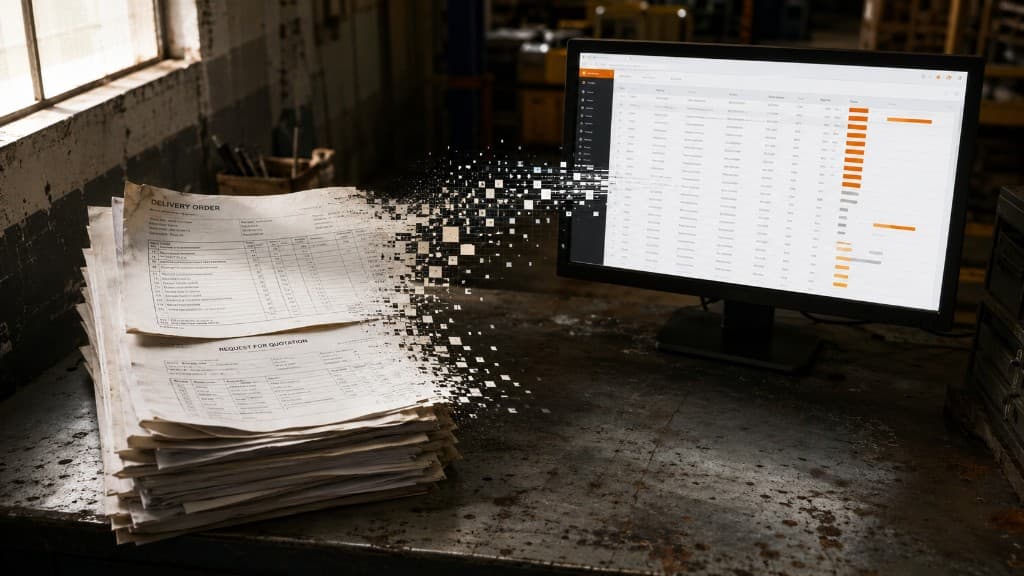
AI ERP is the name for the alternative: a system where the reading, matching, drafting, and checking is done by AI, and your people are promoted from typists to approvers.
The three generations of ERP
Every ERP system in Singapore today belongs to one of three generations. Find yours.
The filing cabinet
The system stores and organizes data. Every action, from order entry to quotation, is performed by a human. Includes most legacy ERPs, accounting-led systems, and Excel-centric operations.
You know you are here if staff retype emails into the system, and reports exist but someone has to compile them.
The connected system
The ERP talks to other software: e-commerce, accounting, logistics. Data flows between systems without double entry. The thinking is still entirely human.
You know you are here if your systems sync, but a person still reads every enquiry and builds every quote.
The working system: AI ERP
AI performs the operational work. It reads enquiries, matches SKUs, drafts quotations and documents, monitors for anomalies, and routes exceptions to a human for judgment.
You know you are here if your team approves work instead of producing it, and order volume can grow without headcount.
What counts as AI ERP, and what doesn't
The term is new, so vendors will stretch it. Here is the honest line.
It is AI ERP if…
- AI reads unstructured input, like a customer email or WhatsApp message, and turns it into structured system actions
- AI matches real-world descriptions to your actual SKUs, including misspellings and shortform
- AI drafts operational documents: quotations, POs, invoices, delivery orders
- Every AI action passes a human checkpoint before it touches a customer
- Results write back into your system of record, not into a side spreadsheet
It is not AI ERP if…
- It is a chatbot bolted onto a dashboard that answers questions about your data
- "AI" means a forecasting graph nobody acts on
- The AI features exist in a demo but require a six-month customization quote to switch on
- It creates a parallel system your team must maintain alongside the real one
- It automates fully with no human checkpoint, then quietly guesses when uncertain
Deployed in Singapore, running today
This page is written by the team that builds these systems. Here is one of ours, live at a Singapore wholesale distributor running SAP Business One.
SKUs cleaned and normalized by AI into a 13-field structure, verified by humans, after 20 years of accumulated data drift
From messy customer enquiry to draft quotation with matched SKUs and tiered pricing, down from ~20 minutes manual
Parallel spreadsheets created. Every result writes back into SAP B1, which remains the single source of truth
Don't read about it. Click around it.
We built a live demo with real distributor workflows: RFQ intake, SKU matching, quotation drafting. No sign up, no sales call required to view it. Watch the 2 minute walkthrough, then break the demo yourself.